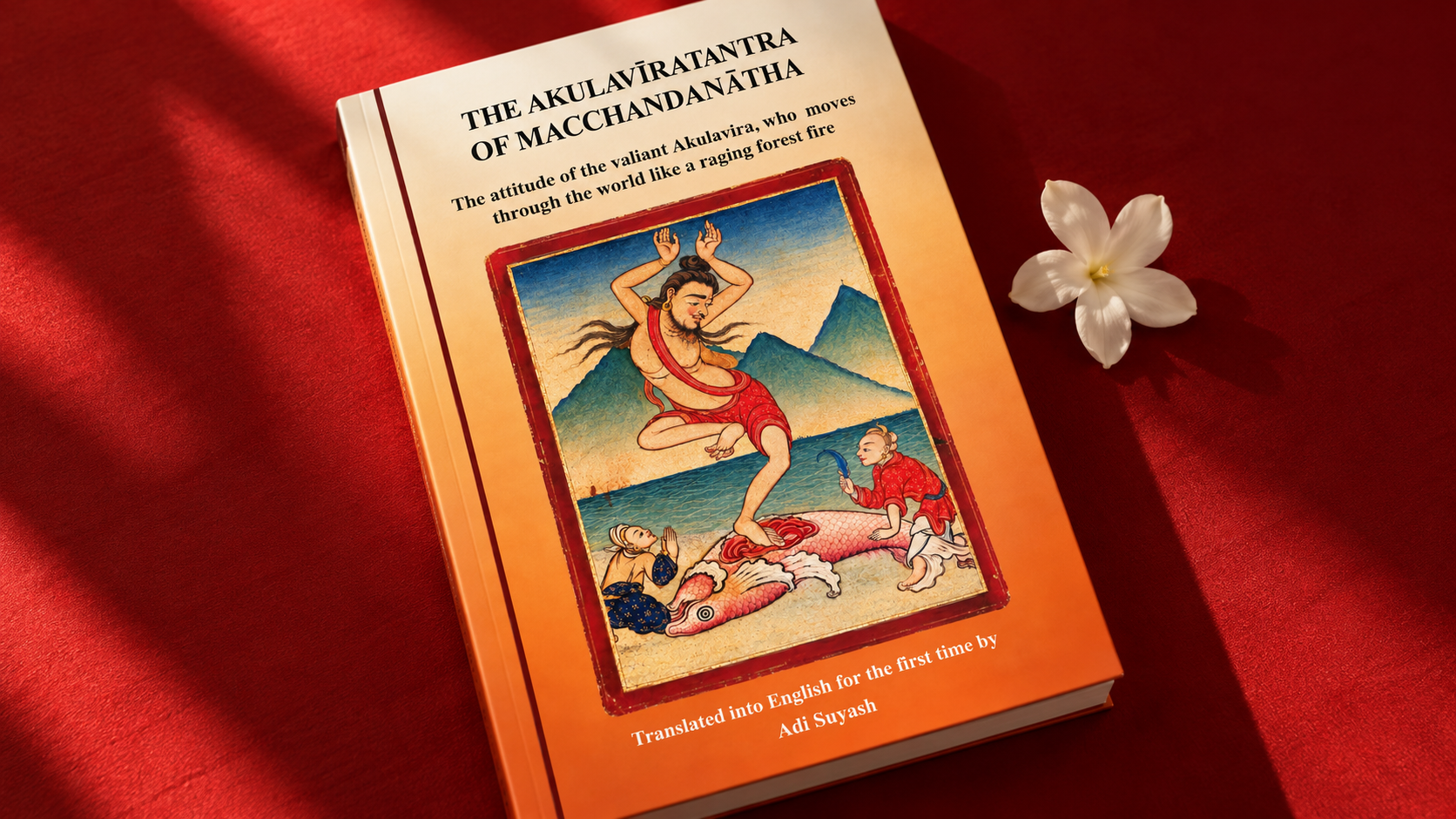
Being translated for the first time, this Akulavīratantra speaks of the supreme transcendental truth, the Anuttara, much like Abhinavagupta’s Anuttarāṣṭikā or the Songs of Aṣṭāvakra. It denies every form of constructed or artificial, sequential process for enlightenment and instead focuses on the real, the essence of everything.
It is the path of the brave, who walk through the world like fire through a forest, reducing everything to a single ash, consuming it all in that one non-dual awareness of Śiva. In a certain sense, this is the path of Śiva rather than that of Śakti. Kula here is Śakti; basically, it means a family, a cluster, or, more specifically, kith and kin originating from the same womb. Basically, it refers to everything in this universe. Akula, on the other hand, is the unborn Śiva, the ground of it all.
This path is for the brave, or vīras, because although it may sound easy, that you do not have to undertake any practice or follow the rules of samayācāra (yes, my students, I am talking to you; do not use this as an excuse!), you must be prepared to live in hell.
Macchanda says:
Whether walking, standing, sleeping, waking, eating, or even in conjugal union (maithuna) (66), amidst fear, poverty, and grief, as well as with respect to various foods and the objects of the senses, he should never entertain anxious scruple or remedial contrivance (cikitsā) at any time (67).
If you can live in any condition, wherever life takes you, in any hell, hungry for weeks, thirsty for days, subjected to third-degree torture in a secret federal prison, with your family dead or everyone having abandoned you, abused and ridiculed, treated like a pig, without a single penny in your pocket, physically paralysed, suffering from innumerable diseases, or enduring unbearable bodily pain, even when you are sinking in piles of faeces and urine, then this path is for you.
Whatever condition life throws at you, and will throw at you, if you can flow with it and live in it without anguish, without seeking a remedy or wondering, “How do I get out of this condition?”, then you are that kind of brave one. This path is for you. You do not need liberation, and, as said, you do not seek it either.
As Abhinava says, without clinging to or fleeing from, enjoy everything as it is, without interpretation. Such people belong to anupāya, the pathless; they do not need a path. This text belongs to that kind of siddha.
For others, who desire a particular kind of life, who wish to enjoy certain luxuries and want life to unfold in a positive way, the path of rules and regulations, such as samayācāra, is there. So, do not use this as an excuse to break them.
I could find no translation of this beautiful text, so I undertook the translation myself, basing it on the published texts of Bagchi and the Muktabodha Library. I have translated it in a scholarly tone, striving to be as accurate as possible, so that it may serve as a critical edition that scholars can work with.
I have also written a short, one- or two-line “superficial commentary” for each passage. These are deliberately limited in scope, explaining the verses only at a superficial and literal level. I intend to write a detailed introduction and commentary soon, exploring the underlying, hidden interpretations and the deeper meaning of the text. However, that will take time. Until then, I am publishing the text without the commentary or introduction so that people can begin discovering it.
The tradition of Macchandanātha must be brought to the forefront once again. He is the rebringer of Kaula in this age, and he is not gone yet. He is here, now. He returns when the time is right, and in disguises that only the rare few will see through.