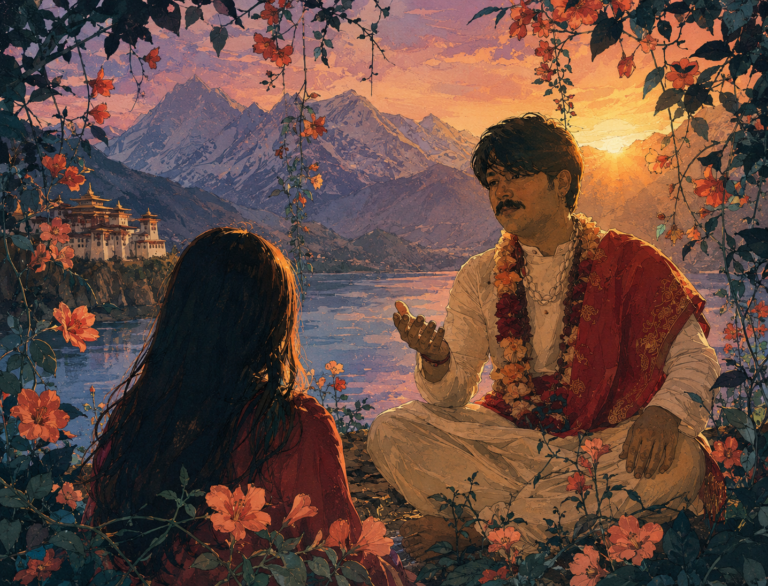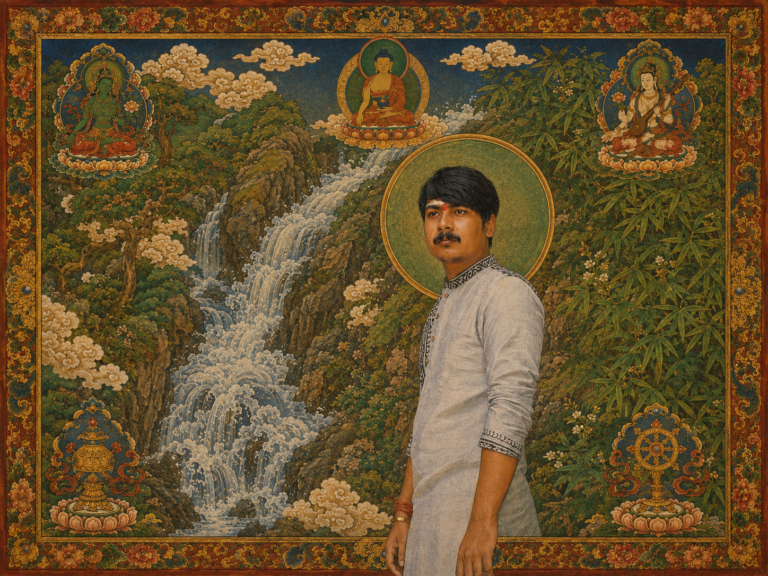
This blog is the fifth installment in a series of recent conversations between Adi Suyash and one of his disciples on Tantric Buddhism. These conversations are lucid and spontaneous, the questions are asked on the spot, unplanned, and the answers are given without preparation or much elaboration. The aim is not to provide an in-depth, traditional, understanding of every topic, but to offer simple, clear explanations that are sufficient to give the reader a basic understanding and a sense of the subject.
Sadhika: How does one attain the state of emptiness? Without a genuine understanding of emptiness, even actions performed for the benefit of others may fail to produce their intended result. According to the tantric tradition described here, practising Tantra without this foundation can even be dangerous. Why?
Adi Suyash: As I said, how do you attain emptiness? Take a thought—or take any object—and trace it back to its source. You will realize emptiness.
Take anything. For example, this is a water bottle. Focus your attention on this water bottle. Where is this water bottle coming from? What is its source? It is arising from within. It is being created by the mind. Go to its source, and you will realize emptiness.
And once you reach its source and discover that there is emptiness there, you will understand that its very nature is also emptiness. The same is true of everything. The nature of everything is emptiness. That is how you realize emptiness.
Without this realization, all these practices are ultimately fruitless, because they will make you believe that the things appearing in them are real. The practices themselves are not real.
[He pauses, then becomes more emphatic.]
Now, if you begin to believe that the form of a deity is actually real, then there is a problem. You are performing tantric practices, imagining yourself as a deity—and then you start believing that this form is genuinely real, that you actually are that deity in some literal sense…
[He laughs lightly.]
Then you’ve got yourself into trouble. Serious trouble. Because now you have begun to see yourself as separate from everyone else.
Sadhika: You start thinking you’re special.
Adi Suyash: Exactly. Because you haven’t realized that I too am the same emptiness as the person standing before me. Do you understand?
Sadhika: Hmm.
Adi Suyash: So when you realize emptiness, you will see the person before you as emptiness, and you will see yourself as emptiness as well.
Emptiness is not superior to emptiness. Neither is emptiness inferior to emptiness. Emptiness is emptiness.
[She listens intently.]
Then you will be able to see everyone with the same vision, with an equal regard. Neither attachment nor hatred will remain toward anyone.
But if you haven’t realized emptiness, you may begin to consider yourself superior because you have assumed the identity of a deity. Then you’ve got yourself into trouble.
All tantric practices can become dangerous and fruitless in that state. You can never become truly liberated. You will simply fall…
Sadhika: …into delusion.
Adi Suyash: Yes. Into a delusion of grandeur.
[He smiles.]
Makes sense? Realized?
Next question.
Wisdom and Skillful Means
Sadhika: How do wisdom and skillful means help in understanding emptiness?
Adi Suyash: Wisdom, of course—wisdom itself means realizing that everything is emptiness. That is what wisdom is.
Wisdom is nothing else.
Knowledge of geography isn’t wisdom. Neither is knowledge of physics, chemistry, biology, or history.
Wisdom is the realization that everything is emptiness.
[He speaks with deliberate simplicity.]
So wisdom gives you the theoretical realization that everything is emptiness.
Compassion is necessary because compassion is a tool—it is a force that helped the Buddha attain parinirvana.
The Buddha saw that the world was suffering. “I must free everyone from this suffering.” That feeling, that intention, was what inspired him to undertake his austerities beneath the Bodhi tree.
The Buddha did not say, “I need to escape from my own suffering.”
What suffering did Buddha have?
He was a king.
[The Sadhika gives a small acknowledging nod.]
He was a king, wasn’t he? He had every kind of pleasure available to him at that time. Every kind of comfort.
He was not even allowed to become ill. He had a comfortable bed. There was no shortage of women around him. Whatever he asked for, the moment the words left his mouth, it was given to him. It wouldn’t even take two seconds.
Everything that a human being could possibly aspire to have—he already had it.
His father, Śuddhodana, had made absolutely certain that this man would lack nothing, precisely so that he would never renounce the world.
And yet, he saw one person growing old. He saw another person dying.
And compassion arose within him:
People are suffering so much. I have never had to suffer like this.
The feeling of wanting to free others from their suffering—that is what compassion is.
And inspired by that very feeling, Siddhartha chose the path toward Buddhahood.
[His tone becomes quieter.]
“First, let me understand the root of suffering. Let me free myself from suffering, so that I may free others from suffering.”
That is the motivation Buddha wants us to cultivate as well.
That motivation became his driving force, and through it he attained Buddhahood.
Our motivation should also become the same, so that we too may realize śūnya—emptiness.
So first, there must arise within you the genuine wish to alleviate the suffering of others. Only then can you attain Buddhahood; only then can you know emptiness.
Because that feeling will keep motivating you.
That feeling itself will become your source.
[He smiles knowingly.]
Because somewhere along the way, you’re going to start enjoying the process.
You will become free from your own suffering—and then what?
You’ll just quit, won’t you?
[The Sadhika smiles, anticipating where he is going.]
Then the gods will send damsels after you.
Indra will send apsarās right before you…
Sadhika: Once we’ve experienced pleasure, we’ll become bound by it all over again. We’ll become attached again, because we’ll start thinking, “I’ve already achieved the goal. There’s nothing left for me to attain.”
Adi Suyash: Exactly.
We begin acquiring a little knowledge, and then we start preaching to everyone. Everyone becomes our admirer. People start giving us money. Everyone starts serving us. Happy!
[He adopts a mock-serious expression.]
“I’m free from suffering now. That’s it. Case closed.”
Why would I need enlightenment anymore?
To free others from their suffering—that is what compassion is.
Suppose the apsarās arrive, we acquire supernatural powers, and we become free from our own suffering. Wonderful. We’re liberated, aren’t we?
I’m no longer suffering. I’m enjoying my life. So why should I continue my sādhanā?
It’s done.
Why do I need enlightenment?
I’m already enjoying every pleasure available to me.
[He pauses.]
So that I may liberate others.
That is why compassion is necessary.
Understood? Next.
Wisdom and Compassion as the Two Aspects
Sadhika: Hmm. In Tibetan Buddhism, there is basically this concept of evam, in which wisdom represents the feminine aspect, while compassion—or skillful means—represents the masculine aspect. Their union is said to represent enlightenment. This is how it is described in tantric Tibetan Buddhism.
Adi Suyash: Mhm.
Sadhika: But my question is this: at the level of knowledge, if two people are both enlightened—both possessing wisdom, both enlightened—then one enlightened being might reach a point where they don’t need anything anymore. They don’t need to do anything. They’re simply happy in their own company because they’re liberated.
So they wander through nature. Perhaps they go into the mountains, practise there, enter samadhi, travel around…
[She smiles.]
Basically, they’re just experiencing the beauty of the world—the beauty of Mother Nature, of the universe.
But then there is another enlightened being, like the Dalai Lama, who, even after becoming enlightened, continues to serve people. He continues trying to free people from suffering. He continues explaining the scriptures, giving teachings and discourses wherever his centres exist.
So, at the level of wisdom, both are the same.
But one is expressing both wisdom and compassionate action, while the other has remained confined to wisdom alone. That person isn’t performing any compassionate action; they’re simply enjoying their own company.
So what is the major difference between the two?
Once liberation has been attained, isn’t it simply our choice? Isn’t it our personal choice whether we choose compassionate action, or whether we simply remain liberated—travel, enjoy ourselves, and live freely?
Adi Suyash: Two things.
[He raises a finger.]
Our choice…
Sadhika: Hmm.
Adi Suyash: …the fact that we think it is our personal choice…
Sadhika: Hmm.
Adi Suyash: …indicates that we might not yet be liberated.
[She looks puzzled.]
Because if it is truly our personal choice, then there is still a personality strong enough to tell us:
“What is the point of alleviating someone else’s suffering? I’m fine. I’m happy. That’s the end of it.”
That means we still perceive a difference between ourselves and the other person.
“I’m enjoying myself. The other person is suffering. So what?”
That means there is still bheda—separation—between the other and ourselves.
Sadhika: Mhm.
Adi Suyash: “I care about myself. I’m enjoying myself.”
That is selfishness.
And if selfishness has appeared, then where is liberation?
I may think I am liberated, but I am not.
Sadhika: But then another question arises…
Adi Suyash: Listen first.
Sadhika: Yes.
Adi Suyash: You’re asking: if both people are liberated, and one person chooses to help others after attaining liberation…
Sadhika: Hmm.
Adi Suyash: …to help others realize the truth as well—if one chooses compassion and the other does not, then what is the difference between them?
Sadhika: Hmm.
Adi Suyash: There is no difference.
Fundamentally, both are liberated.
Sadhika: Hmm.
Adi Suyash: That’s it.
[He leans back slightly, as though the distinction has been settled.]
This teaching isn’t meant for liberated people.
We are not teaching people what a liberated person should do.
The Buddha did not teach his wisdom to liberated people.
The Buddha wasn’t teaching Buddha, was he?
[The Sadhika smiles.]
Buddha was teaching ordinary human beings.
You don’t need to tell a Buddha how to live. You don’t need to tell him whether he should help others or not.
The teaching was for ordinary people.
And for an ordinary person, compassion is essential.
Only then can they attain Buddhahood.
If they do not cultivate compassion, they can never attain Buddhahood.
So if you’re asking about fundamentally liberated beings, there is no difference.
But if you’re asking about an ordinary person, then if that ordinary person lacks compassion—if they’re concerned only with their own enlightenment—it will be very difficult for them to attain enlightenment.
Understand?
If all they care about is their own enlightenment, perhaps they can never become enlightened.
The Illusion of Individual Liberation
Sadhika: So can we say that people who choose only themselves haven’t actually become enlightened, but merely believe that they have?
Adi Suyash: Most probably, yes.
Because it’s still “me, me, me, me, me, me,” isn’t it?
[He laughs softly.]
And even if they have become enlightened, they may have realized only a very small part of the truth.
Perhaps they have realized enough to not be born again.
But they haven’t realized anything fundamental.
Perhaps they have realized only at the level of Puruṣa.
Perhaps they have realized the Sāṃkhya principle that “I am separate from Prakṛti.”
“I am separate from Prakṛti. I am separate from the world.”
Fine.
But they cannot see themselves in the world.
They haven’t understood the unity of Śiva and Śakti—that I myself am the entirety of this world.
[There is a brief silence.]
They haven’t reached the fundamental truth.
Perhaps they’ve gone far enough to become liberated—to no longer have to take birth again.
But they haven’t attained complete realization.
And to attain complete realization, you need both compassion and wisdom.
Once someone has actually attained realization, however, there is no need to tell them whether they should have compassion or not.
That teaching isn’t for them.
It is for the person who has not yet attained realization.
Understand?
Any questions?
Sadhika: Yes. You say someone can realize Puruṣa as separate from Prakṛti and become liberated, but still not have complete realization. Why is that incomplete if nothing remains to be liberated?
Adi Suyash: Nothing remains to be liberated.
But that is not the same as complete understanding.
Complete realization is seeing Puruṣa as one with Prakṛti, because ultimately both are empty.
What Does an Enlightened Being Choose?
Sadhika: I had thought that someone who has become enlightened and simply enjoys their own company, without coming into society to perform compassionate action, was doing so because it was their personal choice. That they had become so free that they were choosing not to do it.
Adi Suyash: Whatever someone does after enlightenment—that is a different matter. For us, it doesn’t matter.
Let’s not judge him.
But until you are enlightened, you must cultivate compassion.
Sadhika: But if someone becomes enlightened, then surely it is their own personal choice whether they come into society and perform compassionate action, or whether they simply remain in the Himalayas and continue with their own practices…
Adi Suyash: There won’t even be a personality left.
[She pauses.]
There won’t be a personality left that can sit there and think about itself.
What does it mean to think about myself?
That possibility simply won’t remain.
Who is this “myself” that they’re thinking about?
Who is this “I” they’re thinking about?
There is no “me.”
There is only everyone.
And everyone is Śiva.
[The Sadhika nods slowly.]
Sadhika: Because they’re still caught in it—that’s why they’ve separated themselves from everything else.
Adi Suyash: Yes.
Only those at the lowest levels of consciousness can be preoccupied with themselves.
Animals think about themselves.
Have you ever seen an animal go out of its way to help someone else?
[He shrugs.]
That’s it.
The animal’s thinking is simply:
“As long as I have food, drink, and sex, I’m sorted. I don’t need anyone. I don’t care about anyone.”
Right?
Sadhika: Hmm.
The Birth of the Dakini in the Charnel Ground
Sadhika: How are Dakinis born in the charnel ground? What is the process? Some Dakinis are said to have been born there, while others were raised there.
Adi Suyash: [He sighs, then answers slowly.] An enlightened being is born from death itself.
That is why they are called dvija—twice-born.
Their birth occurs through death.
Until Siddhartha Gautama dies, the Buddha cannot be born.
Sadhika: You mean through someone’s death?
Adi Suyash: Through their own death; the death of that very person.
Sadhika: Their own death?
Adi Suyash: Their own death.
Sadhika: How?
Adi Suyash: Through their own death, they become enlightened.
The “I” must die before one can become Buddha.
So one becomes Buddha through death.
Their very birth takes place from their own charnel ground—from their own funeral pyre.
Sadhika: But here we’re talking about the death of one’s false identity, right?
Adi Suyash: Yes.
Sadhika: So we…
Adi Suyash: Symbolically.
Sadhika: Symbolically. Right.
Adi Suyash: Hmm.
So that Dakini is a Dakini only once she has died.
She became a Dakini by burning herself.
And she can become a Yogini only when…
What does yoga mean?
Sadhika: Union.
Adi Suyash: Union.
Becoming one with everything. Becoming one with existence.
And becoming one with existence can happen only when that which makes her separate from existence has died.
Sadhika: Ego.
Adi Suyash: Ego.
Once that is gone, she can become one with existence.
She can become a Yogini.
Right?
That is why the charnel ground—the cremation ground.
That is why she is born there, or raised there, grows there.
Understand?
Sadhika: Hmm.
Adi Suyash: Yes, there is another reason: all of those practices—the tantric practices—are performed in the charnel ground.
So she attains enlightenment there, and therefore her birth takes place there.
The one who is enlightened is the Dakini.
So where did she attain enlightenment?
There.
And therefore, that is where she was born.
[He pauses.]
There has been a debate about where Buddha was born.
Buddha was born in Bihar, wasn’t he?
Siddhartha Gautama was born in Lumbini, Nepal.
But the Buddha was born from his own funeral pyre—from the funeral pyre of Siddhartha Gautama, in Bihar.
The Buddha was born beneath the Bodhi tree.
Where is the Dakini born?
In the charnel ground.
Sadhika: So does that mean she becomes enlightened through practising in the charnel ground?
Adi Suyash: Yes.
Most Vajrayāna practices are performed in charnel grounds.
And again, Buddha’s birth also took place in a charnel ground—from his own funeral pyre.
Sadhika: So the Dakini would also have first existed in human form, just like us?
Adi Suyash: Yes.
Emptiness, Compassion, and Buddhahood
Sadhika: Okay, you say that tracing an object back to its source leads to emptiness. If I look at this water bottle and ask, “Where does it come from?”, I can trace it to plastic, petroleum, chemical processes, a factory, human intention, atoms, particles, and eventually whatever physical or metaphysical account I accept.
At no point have I logically demonstrated emptiness.
And if you say, “It arises within the mind,” then I have another problem: why does arising within mind imply emptiness?
Adi Suyash: If you keep tracing the physical source of the bottle through the physical world, you enter an infinite regress. You can keep going backward through causes forever. The existence of the physical world cannot ultimately be understood while remaining within the physical world.
It is like a character in a movie trying to understand his own existence entirely from within the world of the movie. He can keep discovering backstories, and then backstories to those backstories, but there is no final answer within that framework.
We move from the outer world toward the inner.
What we call the external world is prapañcha: form, taste, smell, touch, and sound. Fundamentally, that is what the bottle is.
And where does all of this arise? Through the mind. The observer creates the observed.
Take the old question: if a tree falls in a forest and nobody hears it, did it make a sound? Sound is an experience. And the experience of sound depends upon the hearer. The hearer creates the heard. The same applies to the other senses. So we trace the world back to the mind.
Then we examine the mind itself. We examine thoughts and ask where they come from. Ultimately, no independent source can be found. What is found is nothing.
Sadhika: Are you saying:
- The bottle has no independent inherent existence?
- The bottle is merely a mental construction?
- The bottle is ultimately consciousness?
- The bottle arises from some primordial emptiness?
Because these are not the same philosophical claim.
And if you’re using śūnyatā in the Buddhist sense, then saying “everything comes from the mind” sounds dangerously close to replacing emptiness with mind-as-substrate.
Adi Suyash: These are different descriptions of the same realization. Yes, the bottle has no independent inherent existence. It is like a rainbow… or a movie, It does not exist independently of the screen.
Yes, the bottle is a mental construction. The entire experienced world is a mental construction.
Yes, the bottle is ultimately consciousness, and so is everything else. Buddhism refer to it as śūnya.
Yes, it can also be described as arising from primordial emptiness.
But mind is not the ultimate substrate. Everything appears through mind, but mind itself arises from emptiness or consciousness. That is its real nature and source.
[At some point, many of the people who were around and couldn’t help but overhear the conversation started having their own doubts and questions. There were monks, practitioners, and lay tourists among them. As their confusion grew, they slowly became the ones asking the questions.]
Someone: If emptiness and consciousness are the same, aren’t you turning emptiness into a positive metaphysical substance?
Adi Suyash: These are ultimately unnecessary distinctions. What Nāgārjuna calls śūnya, Śaṅkarācārya calls Brahman. Through neti neti, everything is negated. And whatever remains is Brahman.
But what remains? If anything remains, that too can be subjected to neti neti. So what remains cannot be a conceptual object.
In Trika, this is called Śiva or chaitanya. In the Vijñāna Bhairava, Śiva is also referred to through the language of śūnya. There is also an old Śaiva understanding in which ultimate truth is described as abhāva, emptiness, which is consciousness.
You can call it consciousness or emptiness. You arrive at the same reality.
Someone: But if it cannot be conceptually determined, how can you call it consciousness? How do you move from “it cannot be described” to “it is consciousness”?
Adi Suyash: It cannot be conceptually determined. That is precisely why it is not the mind or any concept.
Consciousness is the screen upon which every concept finds its footing. You can negate everything through neti neti, but how will you negate consciousness when the very act of negation is taking place upon that basis?
Existence is nothing other than our experience of existence. Experience itself is taking place on that screen of consciousness.
Someone: If experience is the world, then a dream is also an experience. So, by your definition, there should be no fundamental difference between the dream world and the waking world.
Adi Suyash: I do not need to defend that separately. Nāgārjuna already dealt with this in the Mūlamadhyamakakārikā, and Gauḍapāda dealt with it in the Māṇḍūkya Kārikā.
Sadhika: Just because the witness cannot be negated, does that make the witness the final reality?
Adi Suyash: Yes. If the witness could itself be witnessed, then it would not be the witness. The witness is final.
Sadhika: Then why call the final reality “emptiness” at all?
Adi Suyash: Because it really is nothing.
Giving it a positive name creates the danger of turning it into another mental construct and then mistaking that construct for the witness.
That is why śūnya is appropriate. Whatever you can think of, it is not that. You cannot know it as an object because the knower itself is that. You cannot experience it as an object because the one experiencing is itself that.
And if everything that is, is experience, then ultimately it is “nothing.”
Wisdom and Compassion
Sadhika: If wisdom is realizing emptiness, and compassion is also necessary, why do you treat them as two separate things? Wouldn’t compassion already follow from realizing non-separation?
Adi Suyash: At the supreme level of realization, they are not separate. Wisdom and compassion unite. This is symbolized in yab-yum, and also through the union of the bell and vajra.
But at the level of the individual practitioner, both aspects must be cultivated.
Otherwise, one can fall into the trap of believing, “I have understood śūnya,” when in reality one has merely adopted a nihilistic attitude.
Compassion is an aspect of the same realization. It helps purify the chitta and bring it toward the non-dual state in which emptiness can actually be realized.
Someone: If everything is empty, suffering is empty, the sufferer is empty, and the liberator is empty. Why should emptiness generate compassion rather than indifference?
Adi Suyash: Compassion is a medium, not the final goal. It is a means of bringing the chitta into the state of non-duality and purifying it.
As long as you are concerned with your own suffering, as long as you remain in jīva-bhāva, trying to avoid pain and suffering, you must not see others as separate. You should try to free them from suffering as well. That is compassion.
You are trying to free yourself from suffering, so you should want the same freedom for others. This is the way.
Once emptiness is actually realized, then you can be indifferent if you wish. Many sages and enlightened beings have been.
But until then, compassion is necessary.
It is like a boat that takes you across the ocean of becoming. Once you have crossed, you no longer need the boat. But while you are crossing, you need it.
Even after you are realised, the boat still exists. So you use it for others. You leave it there for them, so that they too can cross.
Your body and mind, through the practice of compassion, have become so accustomed to functioning like that boat, carrying beings across the ocean of becoming, that once you have crossed, what will the boat do? It will simply continue taking others across.
So even after enlightenment, compassion remains.
Someone: If compassion is necessary for realization, is it actually impossible to attain liberation without consciously cultivating it?
Adi Suyash: Yes, because otherwise there is still duality.
If you are trying to free yourself from suffering but do not care whether others remain trapped in suffering, that is selfishness. It means you are still operating from duality.
There may be countless motivations for spiritual practice, but compassion is indispensable.
Someone: But couldn’t compassion itself become another form of ego? “I am the one who will liberate others.”
Adi Suyash: That is why wisdom must be cultivated alongside compassion.
The mind and body are performing the action. They are not “me.” I am emptiness.
But as long as there is identification with the mind-body apparatus, we continue purifying it by cultivating non-duality.
The practitioner must cultivate both sides simultaneously.
Someone: But saying “I am emptiness” could itself become another spiritual identity.
Adi Suyash: That is only a verbal pointer. It is not something to believe intellectually.
You have to witness it directly through practice, through vipassanā. You observe what is happening and realize it for yourself.
Sadhika: If you have genuinely realized emptiness, then why must you continue helping others? Couldn’t you simply become indifferent?
Adi Suyash: If you have genuinely realized it, then don’t help. That is fine.
But the condition is that you must actually have realized it.
If you have not transcended your own suffering, if you are still trying to avoid suffering in one way or another, then you should try to free others from suffering as well.
The problem is when someone who has not realized emptiness uses the idea that “suffering is empty” as an excuse for indifference.
Sadhika: Then why say that tantric practices are fruitless without realization?
Adi Suyash: The fruit is liberation.
I am not saying the practices produce absolutely no psychological or ethical benefit. I am saying that without realization they have not produced their ultimate fruit.
Sadhika: Couldn’t someone cultivate compassion merely as a technique because they know it will help them attain liberation? Wouldn’t that still be selfish?
Adi Suyash: At the beginning, compassion may indeed function as a means.
But the practitioner has to become so deeply committed to freeing others that they are willing to delay even their own enlightenment.They willingly take on more suffering and do not care about remaining trapped in the world, being reincarnated again and again, until each and every being is free from birth and death.
At that point, it is no longer selfish.
And paradoxically, this very compassion can and does free them, because eventually there is no longer any need to run away from suffering. Running away from suffering, avoiding it, fearing it, that itself is suffering. So when they stop thinking about themselves and their own suffering, the “I” slowly disappears, and with it, the need to run away disappears as well.
Suffering is transcended.
There is no more running.
Deity Practice and Spiritual Ego
Sadhika: Why is deity practice especially dangerous when spiritual ego can arise in any spiritual tradition?
Adi Suyash: It can arise in any spiritual path.
But deity practice carries a particularly strong danger because a deity can be imagined as superior to or different from other beings.
If someone says “Brahman,” they know that Brahman is everything. It is neither more nor less than anything else.
The same applies to śūnya.
But when you identify with a deity-form, there is a greater possibility of thinking, “I am this superior being.”
That is why tantric deity practice requires wisdom alongside it: the real form of the deity is emptiness.
Someone: If the world is created by the mind, doesn’t that make the mind the ultimate substrate?
Adi Suyash: No. “Mind-created” is an important checkpoint in the practice.
You first have to reach consciousness by going through the mind.
The process is:
World → senses → mind → consciousness.
The mind is not the final reality. It is simply the stage through which the practitioner moves inward.
Someone: Doesn’t saying “the world is created by my mind” lead to solipsism? “Only my mind exists; other people are merely projections of me.”
Adi Suyash: “My mind” is already the fundamental error.
There is no “me” and no “my.”
There is no “other.”
Someone: Then if there is no me and no other, who is liberating whom (from their suffering)?
Adi Suyash: There is a “me” and an “other” for as long as you have not realized that there isn’t.
Once realization occurs, that question itself no longer exists.
Deity, Dākinī, and the Charnel Ground
Sadhika: Why is the charnel ground necessary for the Dākinī? If it is symbolic, why not simply meditate on death or emptiness directly?
Adi Suyash: The charnel ground is the best symbol for this.
Our closest encounter with death is generally the charnel ground. And in Vajrayāna, charnel-ground practices are one of the, if not the most important part of tantric practice.
The Dākinī is an enlightened being, and the imagery of the charnel ground connects her directly with the death of the old identity.
The Dākinī is also visualized there because the imagery itself is part of the meditation.
Most importantly, the charnel ground brings the practitioner’s deepest fear to the surface: the fear of death.
Sadhika: So what exactly happens when the practitioner visualizes the Dākinī in the charnel ground?
Adi Suyash: It brings the deepest fear within the chitta directly to the surface: the fear of death.
The practitioner must experience that fear rather than run away from it.
They observe it and discover that the “I” which is afraid of death cannot actually be found as an independent entity.
Someone: Why not simply meditate directly on emptiness?
Adi Suyash: If you can, then do it.
Most people cannot.
They have to be led from form to formlessness.
The Dākinī or Wrathful Deity is a very efficient tool for doing that.