It was in Purnia, on a warm July night in 2003, that this chapter began. The clock had just crossed into the twenty-third of July, exactly midnight, 00:00 hours, when I emerged from my mother’s womb into the world.
At that time, the small town, now far more developed than it once was, would fall almost entirely silent at night. The nursing homes were closed, doctors were unavailable, and considerable difficulty arose in finding a proper medical professional who could conduct the delivery. In the darkness of that night, my family wandered from door to door in search of help. Finally, after persistent knocking (and also kicking) at a nursing home, its doors opened, and I was born.
A normal, healthy delivery. An ordinary child. Nothing outwardly extraordinary. Yet to parents, their child is always special.
Perhaps even more so for my father, because eleven months earlier he had dreamt of my coming. In that dream appeared his ishta-devata—Shiva in the form of the Baidyanath Jyotirlinga, a form he reveres deeply. He has recounted on innumerable occasions that, in the dream, he heard a voice declaring: “A manifestation of Hari-Hara (a union of both Shiva and Vishnu) is coming into your home in the form of a child”.
My father has narrated this incident to me repeatedly over the years, often as an example of the power of Baba Baidyanath, whom he worships with immense devotion. He refers to that Jyotirlinga, situated in what was historically the Mithila region, now in Deoghar, Jharkhand, as the “Kāmnā Liṅga,” the liṅga that fulfills all desires.
He knows well that I do not accept such claims. And so, he would often recount the story almost playfully, as an anecdote: that what he had prayed for came to pass, and the dream proved true. We have argued about it many times.
I would tell him, “What exactly was proven true? There was always a fifty-fifty probability. Either a boy would be born or a girl. A boy happened to be born coincidentally. As for the rest, the idea of an ansha or avatara, that is not something verifiable.”
And he would reply, “You do not know who you are. You are an avatāra. Otherwise, no child could accomplish at such a young age the things you have done.”
Perhaps he is right in his own way. After all, to me, everyone is Shiva.
My father often tells me how people laughed at him when he first spoke of that dream…and how today, he says, those same people laugh no longer!
My grandfather, however, did quietly gave him his approval. Somewhere within himself, he too had experienced a similar dream, though he never openly spoke about it. Both my grandfather and my father were worshippers of the divine feminine. The Brahmins of Mithila were, in general, deeply rooted in the Shakta tradition.
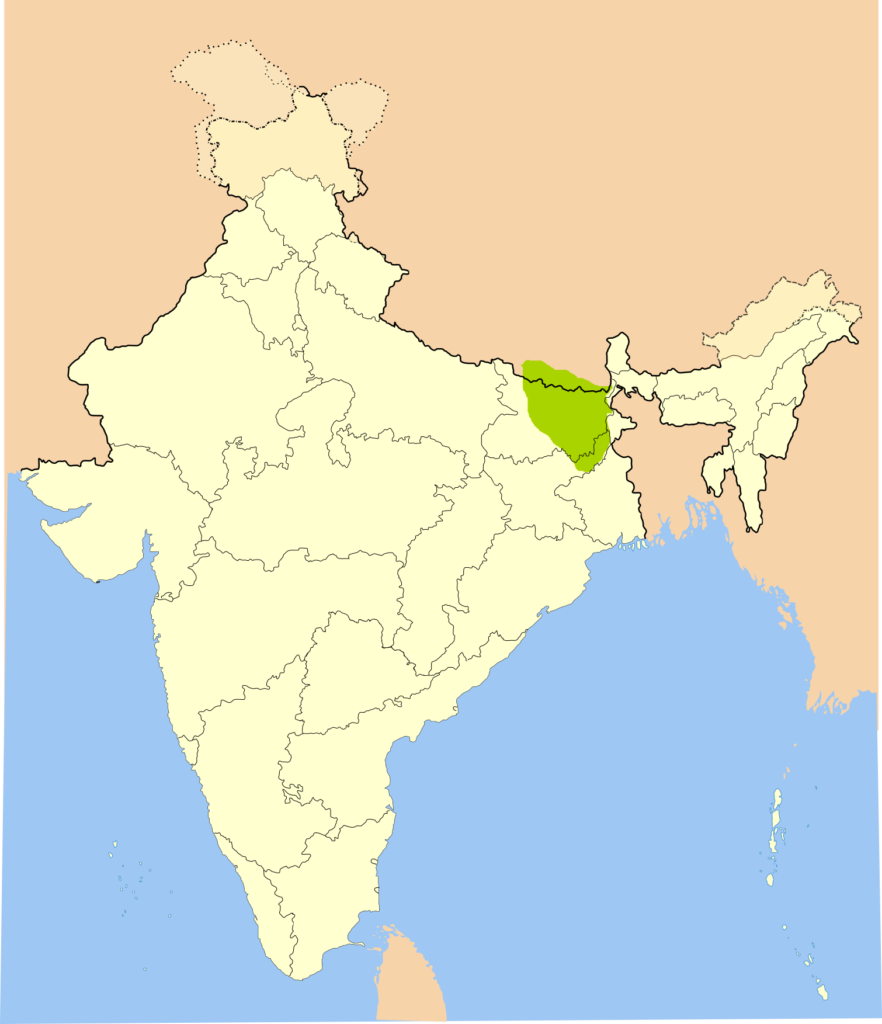
Purnia itself is a part of the ancient kingdom of Mithila. Mithila was the state of Janaka, and one could say that many of the intellectual and spiritual foundations of Hindu Dharma were shaped there, for it was regarded as a great center of Brahminical learning and scholarship.
The land historically described as Mithila stretched:
From the Gandak in the west,
to the Koshi in the east;
from the Ganga in the south,
to the Himalayas in the north.
Of course, this was only a broad cultural and geographical description, not an exact political boundary. Rivers themselves changed course over centuries, and the civilization extended beyond them as well. At different times, Mithila’s influence reached southward beyond the Ganga toward Baidyanath Jyotirlinga, and even into parts of Bengal.
Thus, the region historically associated with Mithila included the areas of present-day Nepal lying between the Gandak and Koshi rivers, along with much of present-day Bihar extending southward beyond the Ganga.
As the story is told, when Krishna was once traveling above Mithila in the Pushpaka Vimana, he pointed toward the land below and said to Rukmini,
“Beloved, behold Mithila. Here, upon the tongue of every person, the goddess of learning herself dances.”
Mithila, also known as Videha, was regarded as a land of scholars and philosophers. Its king was Janaka. Goddess Sita was born there. It stood as one of the great centers of learning in the ancient world. Sages such as Yajnavalkya and Gargi Vachaknavi lived there. Ashtavakra is associated with that sphere, as is Kapila. In many ways, the intellectual foundations of later Hindu and Vedic philosophy were deeply shaped within this region.
Indeed, one could argue that from the larger region of Bihar emerged almost all of the religious traditions of Bharat. It was here that prince Siddhartha became the Buddha. It was here that Mahavira became the Jina. Guru Gobind Singh was born here, from whom the foundations of the Khalsa tradition later arose. Aryabhata and Nagarjuna too are associated with this civilizational sphere—from zero to śūnyavāda, one may poetically say, much emerged from this soil.
Even the name “Bihar” itself reflects this legacy. It derives from the word vihara—a monastery, a place of learning and contemplation. In that sense, the very name Bihar means a land of learning.
The history and culture of Bihar are such that they connect, in one way or another, with nearly the entire Indian subcontinent.
Through Janakpur, the legendary land of Janaka and Sita, Bihar becomes inseparably linked with the story of Rama and the civilizational imagination of North India. Through sages such as Yajnavalkya and Kapila, it connects itself to the roots of Vedic thought and philosophy.
And because great universities such as Nalanda Mahavihara, Vikramashila, and Odantapuri once flourished here, Bihar also stands connected to every Buddhist land touched by the teachings of Buddha—from Tibet to Japan, from Thailand to countless other regions across Asia.
Then there is Vidyapati, whose songs of love devoted to Radha and Krishna, works of extraordinary beauty that everyone should read at least once, went on to inspire Chaitanya Mahaprabhu himself. For a long time, many in Bengal even claimed Vidyapati as one of their own. In this way, Bihar and Mithila became deeply interwoven with the traditions of Radha Krishna as well.
At the same time, Śākta Tantra was practiced here with immense intensity, especially throughout Mithila. The more recent capital of Mithila, Darbhanga, is often interpreted as deriving from Dwar-Banga—“the gateway to Bengal.” Through this, the region remained culturally connected with Bengal and Odisha, lands deeply shaped by Tantra and devotional traditions.
Through Guru Gobind Singh, Bihar is connected with Punjab and the Sikh tradition. Through Mahavira, it is linked with the Jains.
In many ways, Bihar stood as the heart of the Indian subcontinent—spiritually, intellectually, and politically alike.
That is why historian Romila Thapar noted that much of Indian history is, in many ways, the history of Bihar.
The rest, you may discover for yourself. If you study the history of this land, you will only become more fascinated by it. If I continue, I may end up writing endlessly about the greatness of this place alone. I take immense pride in being from Bihar, and especially from Mithila. One of my aspirations, too, is to see Bihar restored to the fullness of its former glory.
In Mithila there lies a place called Purnia. The name is believed to derive from the word purain—the folk Maithili term for the lotus. Thus, Purnia may be understood as “the place where lotuses bloom,” a kind of city of lotuses. The region has long been filled with ponds and wetlands where lotuses once flourished in abundance. Today, however, one is more likely to see these waters covered with the cultivation of makhana than with lotus flowers themselves.
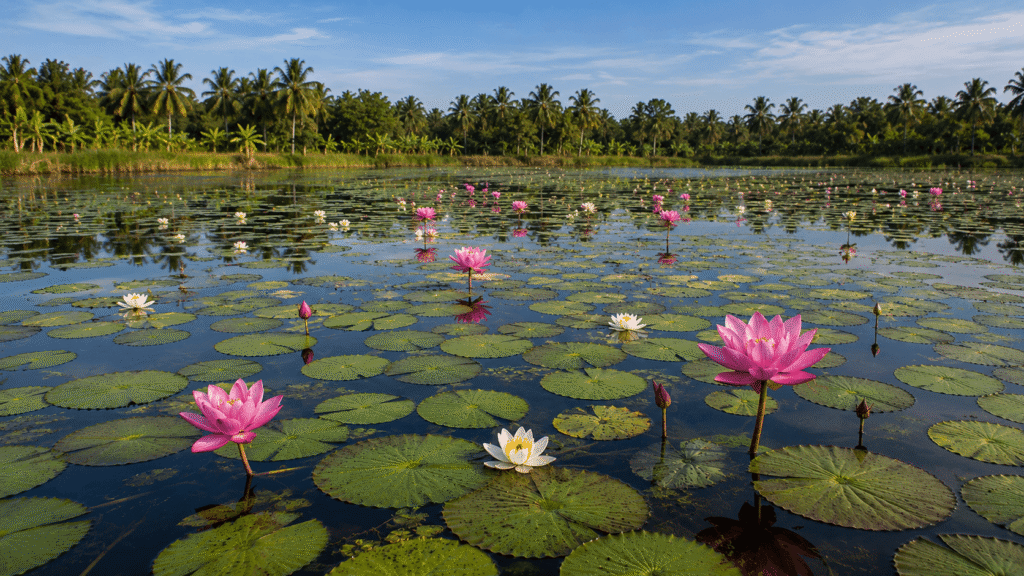
And so, from this land where lotuses bloom, I too blossomed like a lotus.