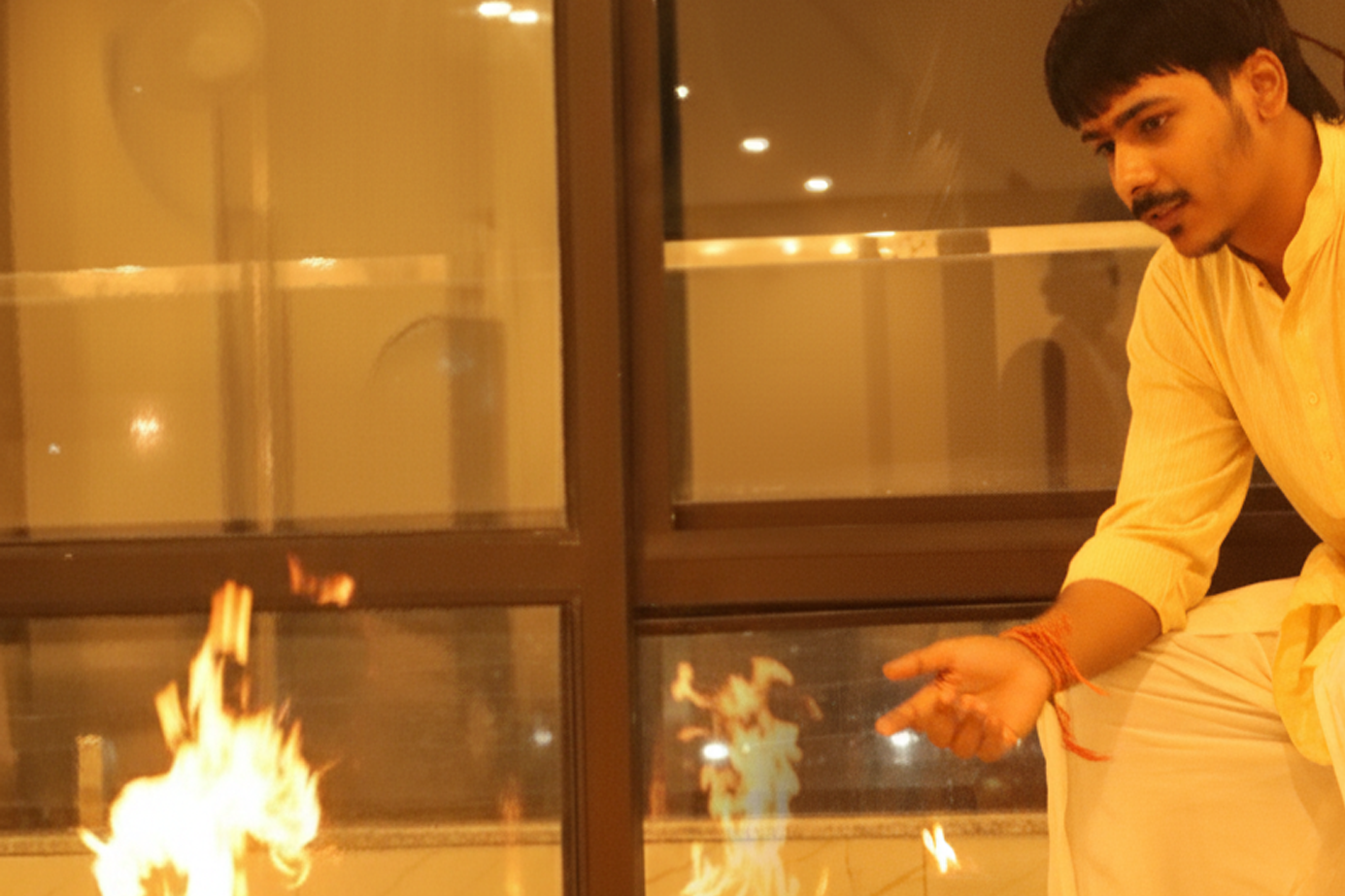
From childhood, I have held a distinct and enduring love for fire, a fascination that remains alive within me even today. I once kept a collection of lighters (though it was often misunderstood by others…). At home, there were substances such as sulphur, coal, and potassium nitrate (there still are). These three, when combined, form gunpowder. I was constantly igniting or setting something off (…that, I still do).
Exothermic reactions deeply intrigued me; the release of heat felt almost mystical. It was while gazing into fire that my spiritual journey first began. My earliest sādhana, too, was connected with fire. Perhaps this was one of the reasons why Rudra was so dear to me. Shaiva tantrics have, since ancient times, shared a profound and intimate relationship with the fire ritual.
In truth, the most ancient form of Shiva, of Rudra, is fire itself. You may have heard that Shiva first manifested as a boundless pillar of fire, without beginning or end, without any perceivable limit. In the Vedic age, the fire that was worshipped was none other than Shiva in his symbolic form.
The Ṛgveda states this explicitly:
“Tvam Agne Rudro…”—“O Agni, you are Rudra.”
Firewood for the sacred flames was traditionally brought upon a bull, which later came to be known as the vehicle of Rudra.
At the core of a flame, there is often a blue center, you can observe this even in a simple candle. The blue flame signifies complete combustion, a state of total burning. It exists at the very heart of the fire; Rudra’s blue throat symbolizes this inner core. His body is described as red, in a constant dance, while his hair is black and white, wild and matted. The red represents the blazing fire, and the hair symbolizes smoke rising from it.
It is said that within him, instead of blood, there is ash. According to one legend, when Shiva cut open his own body, ash emerged in place of blood. In the same way, within fire, nothing remains but ash.
Thus, from the earliest times, fire has been the symbol of Rudra, and it is for this reason that fire is worshipped. Here, fire is not just a physical element; it is a symbol of consciousness itself. Fire is that which dispels darkness, and engulfs all within itself, hence our ancestors revered and worshipped it. Indeed, fire symbolizes consciousness because consciousness consumes everything and renders it one. Fire reduces all to ash; if we were all to burn, what distinction would remain in our ashes? None at all. In the same way, when you become one with consciousness, the entire world is dissolved within it, and all divisions cease to exist. It is for this reason that fire is worshipped.
When you offer oblations into the sacred fire, regard the act as symbolically returning the entire universe into consciousness, merging it back into oneness. This is the spirit in which the worship of fire may be performed.
If possible, perform a small havan at home daily or at least weekly. Learn to conduct it yourself. And if that is not feasible, at the very least, light a lamp each day. More importantly, keep the inner flame of consciousness kindled at all times, remain conscious, abiding as the witness.